Namelix Alternatives: Naming Tools and Domain Checks
Compare Shopify, Looka, Namify and ChatGPT for business naming, with tested examples, domain-check limits and a practical shortlist scorecard.
For a direct Namelix alternative, start with Shopify for description-based ideas or Looka for categorized names and domain checks. Consider Namify if domain research is your main task. Use ChatGPT when you need to develop a naming brief or challenge a shortlist through follow-up questions.
Choose by the part of naming that is slowing you down. A generator can supply candidates; deciding whether a name fits your customers, is easy to say, and can be used safely takes a separate review.
Compare the alternatives by task
| Tool | Useful starting point | What to check next |
|---|---|---|
| Shopify | Generate ideas from a short business description | Screen length and spelling; domain and store purchases are separate |
| Looka | Browse invented, compound and multiword names | Open individual domain results; confirm social handles yourself |
| Namify | Explore names alongside domain options | Check registration costs and included benefits before buying |
| ChatGPT | Refine a brief and critique competing names | Verify factual claims about domains, handles and existing brands independently |
| Namelix | Keep exploring short, brandable names | Change filters or your brief before switching tools |
Shopify: try a description first
Shopify’s generator accepts a business description with a 120-character limit. We generated suggestions without signing in. This is a useful starting point when a few keywords leave out the audience or tone you want.
The tradeoff is constraint checking: review each suggestion rather than assuming the generator followed every instruction. Its domain-search and store-launch paths also introduce separate decisions and costs.
Looka: explore different name structures
Looka accepts keywords, offers a length filter, and groups names by structure. Its individual-name view connects naming to domain checks and logo ideas. The generator is free; downloadable logo packages and brand kits are paid products.
Use it when you want to compare naming styles. A domain result does not establish social-handle availability or permission to use a brand name.
Namify: prioritize domain research
Namify’s current site describes AI-assisted domain search, business-name ideas, social username checks and trademark screening. This option is worth evaluating when choosing a usable domain is central to your brief. Some advertised logo benefits depend on registering selected domain extensions.
We reviewed its product description but did not run its generation or registration flow for this article. Treat its listed checks as provider-described features, and confirm the final results and purchase terms yourself.
ChatGPT: develop the brief and challenge the shortlist
ChatGPT lets you revise instructions conversationally: ask for a different tone, remove confusing spellings, or explain why a candidate fits a specific customer. OpenAI documents free access, with limits that vary by tool and plan.
A useful follow-up is: “Which of these names is hardest to understand after hearing it once, and why?” Verify any answer claiming a domain or handle is available against the relevant service. We did not benchmark ChatGPT outputs against the generators below.
What we observed in two browser tests
On October 3, 2026, we tried a fictional scheduling product for solo yoga teachers. Shopify received the full brief below; Looka received the keyword yoga, because its interface is organized around keywords. These are workflow spot checks with different inputs, rather than a controlled quality ranking. Generated suggestions can change between runs.
Calm scheduling app for solo yoga teachers. Short, easy-to-spell name. Avoid yoga puns.
Shopify: results included Plenara, Velora and Soothea, alongside Gentle Flow Organizer and Tranquil Time Tracker. The longer suggestions show why a “short” instruction still needs manual screening. We did not verify the suggested names’ domain or trademark status.
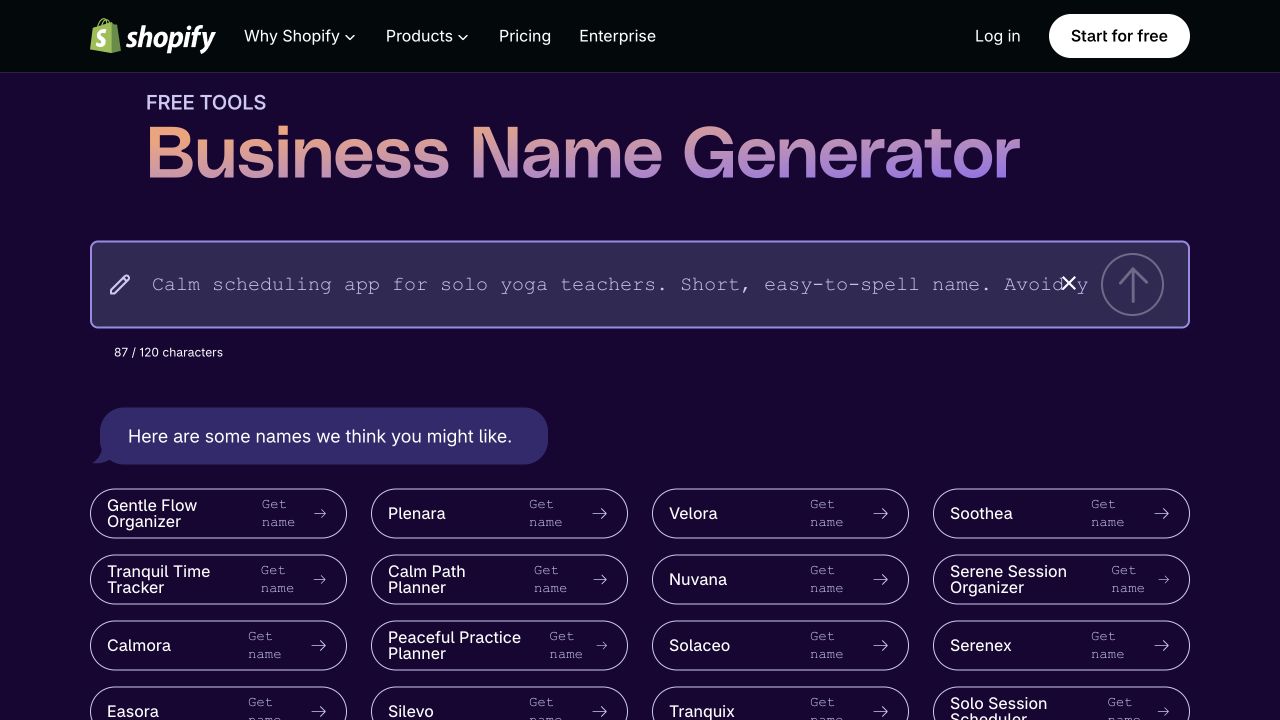
Our browser capture from the fictional brief, October 3, 2026. These examples are candidates for evaluation, not recommended brand names.
Looka: the yoga search produced invented and compound categories, including Elkarma, Upyoga and YogaMate. Opening Elkarma and loading domain results showed an “Open Link” action for its .com and “Register” actions for some other extensions. This illustrates why a general “Domains available” label is insufficient when you need one particular extension. The social section returned no visible results after we loaded it in this session; we could not verify handle availability.
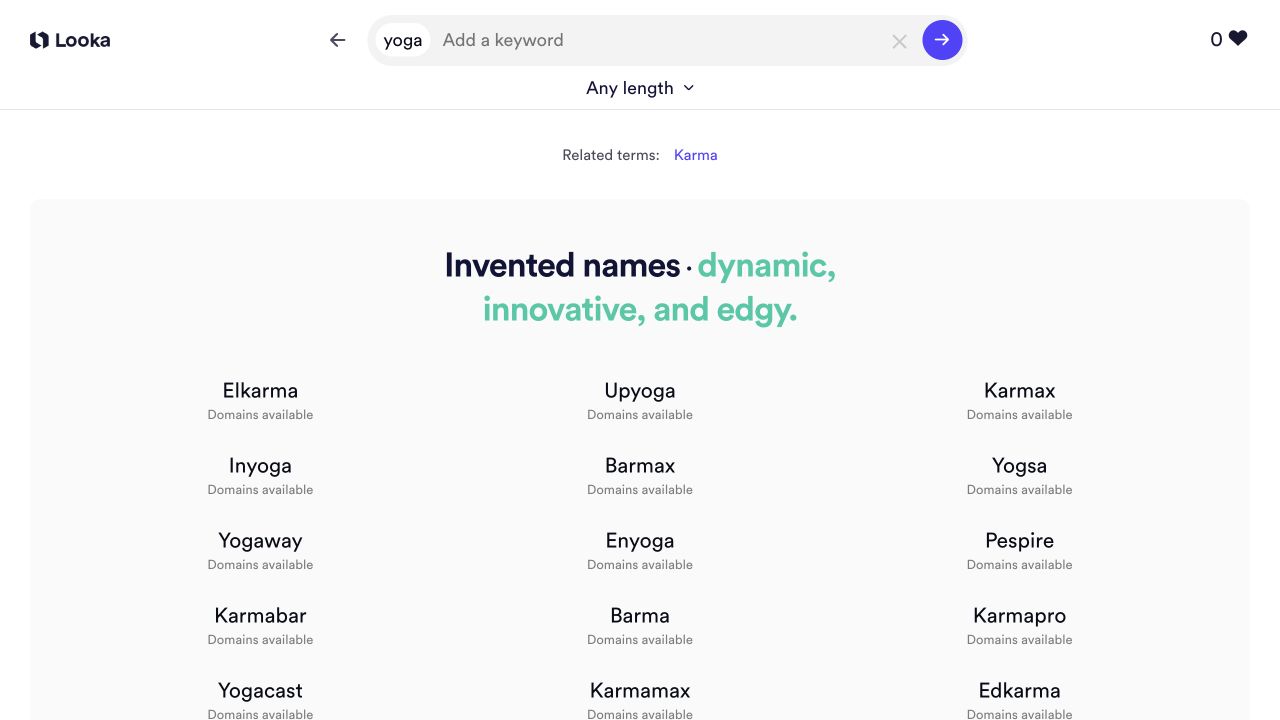
Our browser capture, October 3, 2026. Availability can change; recheck individual domains at a registrar.
Turn a naming brief into a shortlist
Before generating another hundred ideas, decide what a name must communicate and what would disqualify it. Use this brief in a conversational tool, or reduce it to the keywords a generator accepts:
Product: [what it does]
Customer: [one specific audience]
Tone: [two qualities, such as calm and practical]
Naming direction: [descriptive, invented, or a blend]
Constraints: [length, spelling, words to avoid]
Future scope: [what the business may offer later]

Suggest 12 candidates in three naming directions.
For each, explain its fit and one possible weakness.
Do not claim domain, trademark or social-handle availability.
Keep five candidates and run the same review on each. The scorecard below is our suggested decision framework; it is not a validated predictor of business success.
| Check | Pass condition | Reason to revise or reject |
|---|---|---|
| Spoken clarity | A listener can repeat and spell it | You must explain punctuation or unusual spelling |
| Customer fit | It supports the audience and tone in your brief | It implies a different product or market |
| Room to grow | It still fits one plausible future offer | It locks you to one temporary feature |
| Distinction | You can explain how it differs from nearby brands | Searches reveal confusingly similar businesses |
| Practical availability | You have checked the required domain and handles | The exact assets you need are taken or unsuitable |
Test the top two names in a sentence, on a small phone screen, and in a simple wordmark. Canva can help with a visual mockup; a polished logo alone does not fix an unclear name.
Check domains, handles and brand conflicts separately
- Domain: search the exact spelling and extension at your chosen registrar. Record the date, initial price and renewal terms. An available extension may still be the wrong choice for your audience.
- Social handles: check the networks you will actually use. Confirm the exact username, rather than relying on a general availability badge.
- Existing uses: search exact and similar names, including plausible misspellings. Look for businesses a customer could confuse with yours.
- Trademark review: use the relevant official search service, such as the USPTO trademark database for the United States. A database search or generator badge is only one screening step, not legal clearance. Get qualified advice when choosing a business name with meaningful legal exposure.
Keep these checks alongside the shortlist. If a favorite fails a practical requirement, revise the brief and generate a small new set instead of forcing a compromised spelling.
When it makes sense to keep Namelix
Stay with Namelix if your main task is exploring short, brandable names. Its official site describes filters for length, keywords and domain extensions, plus saved-name preferences. First try a clearer brief or a different naming direction.
Switch to a description-based generator when keyword results are too narrow, a domain-oriented tool when availability is the bottleneck, or a conversational assistant when you need to explain and critique your choices.
Frequently asked questions
Which free Namelix alternative should I try first?
Try Shopify for a short description or Looka for keyword-based categories. Both generated names in our browser tests without an account. Domain registration, store plans and downloadable branding assets are separate from free idea generation.
Which alternative checks domains and social handles?
Looka and Namify describe both features. We observed Looka’s individual domain results, but its social section produced no visible results in our session. Recheck the exact domain and usernames through their respective services before committing.
Can I use ChatGPT instead of Namelix?
Yes, for brainstorming and evaluating a brief. Use a dedicated naming or domain tool if its filters and availability interface suit your workflow better. Neither approach removes the need to screen the final name.
Should I pick the name with the best-looking logo?
Evaluate clarity, customer fit and practical availability first. Compare visuals after a candidate passes those checks. A logo should help communicate a sound choice.
For more tool comparisons and refreshed reviews, use the email signup below. You can also explore our AI tools directory and marketing tools.
If this post created workflow interest, send the next click somewhere narrower
These are the strongest automation-intent destinations for blog readers who are ready to compare tools, see examples, get a direct answer, or justify a rollout.
Category Hub
Compare Automation Tools
Start with the workflow bottleneck, then narrow the shortlist across automation platforms and orchestration tools.
Guide
See Workflow Examples
Route operators and service teams to niche-matched Zapier workflow ideas instead of generic automation advice.
Quick Answer
Answer the Start-Here Question
Use the direct recommendation page when the visitor wants a practical starting point, not another long browse.
Editorial Roundup
Best AI Automation Tools in 2026
Send readers to the automation roundup when they need a narrative view of the landscape before comparing vendors.
Calculator
Run the ROI Math
Give skeptical operators and budget owners a payoff-oriented next step instead of another generic article.
Get new AI tool comparisons and updates by email
Subscribe for refreshed reviews, new comparison guides, and practical workflow picks from AIToolIndex.
Weekly AI tool updates, comparison refreshes, and practical workflow picks.